China is a major sourcing destination for folding shelves, serving buyers who need space-saving storage for homes, shops, workshops, and commercial interiors. This guide introduces ten manufacturers in China and offers a practical starting point for comparing their products and capabilities. The selection process should look beyond attractive photographs. Product range, materials, hinge design, finish quality, customization options, and communication all deserve attention.
Details matter. A shelf that looks sturdy online may perform differently once installed and loaded. Buyers should ask for clear specifications, including dimensions, recommended load capacity, mounting requirements, and available finishes. Where possible, request product samples or documented quality checks before placing a large order. A polished website is not proof of consistent manufacturing.
The manufacturers featured in this overview may serve different needs, from compact household shelves to products designed for retail or light-duty workspaces. Their suitability depends on your project, installation conditions, order volume, and delivery expectations. Compare quotations carefully, and confirm what each price includes. Packaging, customization, and shipping terms can change the final cost.
No single supplier fits every project. Some information may also change, so verify current product details directly with each manufacturer. Use this list to narrow your options, prepare better questions, and assess whether a supplier can meet your practical requirements.
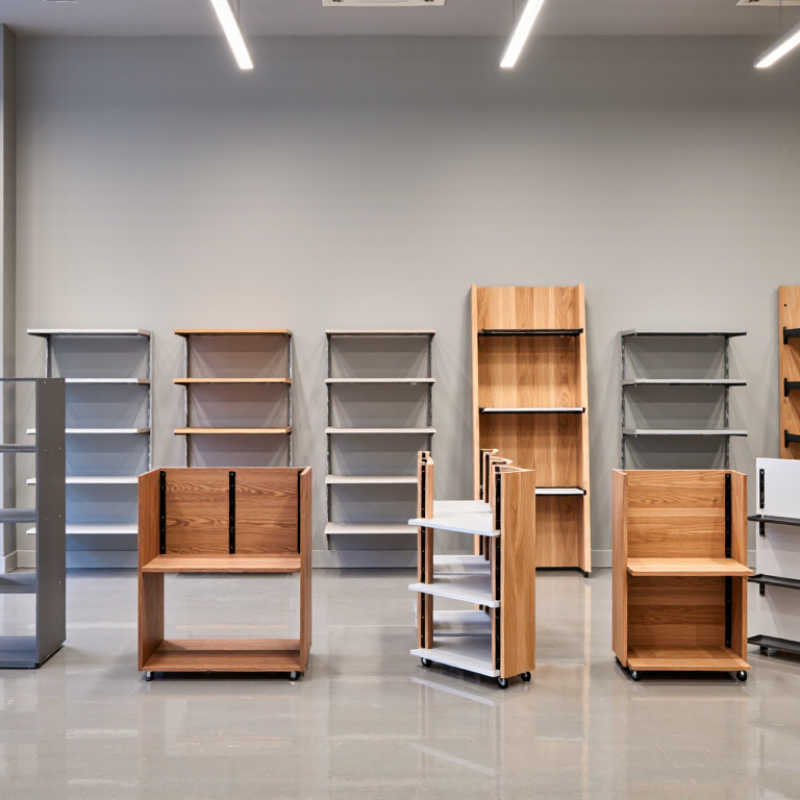
Folding shelves generally come in three forms: wall-mounted hinged units, freestanding racks, and folding wire shelves. Wall-mounted designs free up floor space, but need suitable fixings and careful load checks. Freestanding racks work well in laundry rooms, workshops, and retail stock areas. Wire decks let air and water pass through; solid metal or engineered-wood panels offer a flatter surface.
Steel is a common choice for heavier loads, while aluminum can reduce weight. Engineered wood creates a smooth surface but may not suit persistently damp areas. Polymer shelves are easy to clean, though some designs can flex under concentrated loads.
The World Steel Association’s World Steel in Figures 2025 reports 1,882.6 million tonnes of crude steel production in 2024. The OECD’s Global Plastics Outlook (2022) reports 460 million tonnes of plastic production in 2019. These figures describe material industries, not shelf demand or product quality. That distinction matters.
Match the material to the room, load, and expected folding frequency, then check the manufacturer’s stated capacity. A specification can look precise and still miss real use.
Assessing a folding shelf manufacturer starts with the product’s intended use, not a catalogue photo. Ask for drawings that show open dimensions, folded depth, material thickness, hinge type, and rated load. Check whether the stated capacity applies to one shelf or the full unit. Details matter. Request a sample and measure it yourself; a few millimeters can affect wall clearance or fit.
Inspect welds, edges, and moving joints under bright light. Look for rough burrs, uneven coating, loose pins, or hinges that catch during repeated opening. Test it under load, using a controlled weight and a level surface. The test should reflect real use, but a short trial cannot predict years of service. Ask how the factory checks cycle durability, corrosion resistance, and batch consistency, and request records linked to the production lot.
Review how design changes are managed. A small bracket revision can alter folding clearance, while old drawings may remain in circulation. Confirm sample approval, inspection points, packaging protection, lead time, and defect-handling terms in writing. A factory visit or independent inspection can help verify whether processes match stated claims. I would not rely on paperwork alone. It helps, but people can miss things; compare a production sample with the approved drawing before shipment.
China’s folding-shelf manufacturers vary in materials, production scale, and customization. One profile focuses on compact steel shelves for utility rooms, with welded frames and powder-coated finishes. Another specializes in aluminum designs that are easier to move between work areas. A third makes wooden folding shelves for home interiors, where surface texture matters as much as storage. A fourth concentrates on plastic models for lightweight, everyday use. Different needs, different builds.
Some manufacturers develop wall-mounted shelves with folding brackets, while others produce freestanding units that collapse for transport. A separate group serves commercial buyers with wider shelves and reinforced joints. Their product sheets may look similar, but hinge design, edge finishing, and stated load capacity deserve close inspection. Ask how capacity was tested. Details matter.
The remaining profiles include makers offering custom dimensions, suppliers focused on export-ready packaging, and factories with broader hardware capabilities. Custom work can help when a room has an awkward corner, though it may add time and cost. Packaging also matters: a shelf that arrives with bent brackets is no bargain. Request a sample, review assembly instructions, and confirm dimensions before comparing quotes. One caveat: published specifications do not always show how a shelf performs after repeated folding.
Note: This is a category-level buying guide, not a verified ranking or a directory of ten identified companies. The profiles summarize common folding-shelf product specializations and manufacturing options; specifications, certifications, and availability vary by supplier and model and should be confirmed directly.
| Profile | Typical product focus | Common materials and construction | Useful design options | Buyer checks |
|---|---|---|---|---|
| 1. Wall-mounted utility shelf | Space-saving storage for homes, workshops, and service areas | Steel brackets with a metal, wood, or engineered-wood shelf panel | Manual fold-down support, different shelf depths, wall-fixing options | Load rating, wall and fastener compatibility, folding-cycle test results |
| 2. Kitchen and dining shelf | Compact food-preparation or occasional dining surfaces | Coated metal supports paired with wood-based or metal panels | Rounded corners, wipe-clean surfaces, compact folded profile | Panel material, edge finish, hinge security, care instructions |
| 3. Laundry and utility-room shelf | Folding surfaces for laundry rooms and household utility spaces | Often metal frames; shelf-panel materials depend on the model | Moisture-conscious finishes, wall-mounted layouts, optional guard edges | Corrosion-test method, coating details, installation requirements |
| 4. Bathroom folding shelf | Small storage or temporary support in bathrooms and wash areas | Metal or plastic components, with material choices varying by product | Compact dimensions, drainage-friendly surfaces, corrosion-resistant finishes | Suitability for damp environments, cleaning guidance, mounting method |
| 5. Heavy-duty workshop shelf | Fold-away storage or work surfaces for garages and workshops | Heavier-gauge metal supports with metal or reinforced panels | Reinforced brackets, locking supports, larger-format shelves | Tested load capacity, load distribution, weld and hardware inspection |
| 6. Commercial and retail shelf | Foldable display or back-room storage for shops and commercial spaces | Metal frames with shelf panels selected for the intended application | Custom dimensions, branding or color options, repeatable batch production | Sample approval, packaging protection, finish consistency across batches |
| 7. Balcony and outdoor shelf | Space-efficient surfaces for balconies and other outdoor settings | Metal or outdoor-suitable panel combinations, depending on the specification | Weather-conscious coatings, drainage features, compact folding hardware | Exposure limits, corrosion protection, maintenance and anchoring guidance |
| 8. Furniture-grade folding shelf | Interior shelves designed to coordinate with home or office furniture | Wood or engineered-wood panels combined with metal or furniture-style supports | Decorative finishes, concealed hardware options, coordinated dimensions | Panel composition, finish samples, hardware life, edge durability |
| 9. OEM/ODM folding-shelf supplier | Private-label or customized products based on buyer requirements | Material and construction are set by the agreed product specification | Custom dimensions, finish selection, packaging, and product modifications | Tooling ownership, approved drawings, MOQ, lead time, quality-control plan |
| 10. Export-oriented folding-shelf supplier | Products prepared for overseas wholesale or retail orders | Varies by model; material declarations should be requested for each SKU | Export packaging, carton labeling, document support, shipment coordination | Applicable test reports, destination-market requirements, carton dimensions, Incoterms |
When comparing China’s folding-shelf manufacturers, start with the product range, not the catalogue size. Check whether each supplier offers wall-mounted and freestanding models, steel or aluminum frames, and shelves suited to kitchens, workshops, or retail displays. Grand View Research valued the global furniture market at US$556.3 billion in 2023; this broad-market figure signals scale, but says little about folding shelves specifically. Treat it as context, not proof of supplier capability.
Customization is most useful when it is measurable. Ask for drawings showing shelf dimensions, hinge positions, finish, and rated load. Request samples that match the proposed production materials, then compare welds, folded edges, and movement under repeated opening. Details matter. A custom color is easy to promise; consistent coating thickness across a production run is harder. Confirm how the supplier handles design changes and what inspection records accompany each batch.
Quality claims need evidence. ISO 9001 certification describes a quality-management system, not the performance of a particular shelf. Request load-test results, inspection criteria, and corrosion-test conditions; ISO 9227, for example, specifies salt-spray testing methods, not a guaranteed service life. A rated load without test setup is incomplete. Even a clear report cannot predict every installation, and that limitation deserves attention. Compare suppliers by the clarity and relevance of their evidence, not by polished certificates alone.
When comparing folding-shelf manufacturers in China, look beyond polished catalog photos. Check steel thickness, hinge design, edge finishing, and rated load per shelf. Ask for test records showing how the shelf performs under load and after repeated folding. Ask for evidence. Confirm that the quoted capacity applies to the complete shelf, not one bracket. A neat sample can still hide inconsistent welds or sharp edges.
Deloitte’s 2019 Smart Factory study reported that 86% of surveyed manufacturers expected smart-factory initiatives to drive competitiveness within five years. For buyers, that makes traceability and process control worth checking: can the factory link material batches to inspection records, and explain how defects are handled? I would treat digital dashboards as a starting point, not proof. Request a pre-production sample, inspect its hinge movement, and measure it against the approved drawing.
Logistics and communication matter, too. The World Bank’s 2023 Logistics Performance Index ranked China 19th among 139 economies, with a score of 3.7 out of 5. That broad result cannot predict one supplier’s delivery record. Ask for recent on-time shipment figures, packaging photos, carton dimensions, and a written lead-time schedule. Test the packing with a small trial order if practical. Details get missed. Record finish, dimensions, hardware, and acceptance criteria in the purchase specification before production begins.
Common options include hinged wall units, freestanding racks, and folding wire shelves. Each fits different spaces.
Steel often suits heavier loads, while aluminum keeps a rack lighter. Check the stated capacity and shelf setup.
Wire decks let air and water pass through. Engineered wood may struggle with persistent dampness.
Use suitable fixings and inspect the wall. Confirm the load limit; estimates can still be wrong.
Fold a sample repeatedly and watch for wobble or rough movement. Small detail, big difference.
Check dimensions, hinge positions, finish, and rated load. A custom color alone proves little.
Request load-test results, inspection criteria, and corrosion-test conditions. A polished certificate is not enough.
Freestanding racks often work in these spaces. Match the material and shelf surface to the task.
Not completely. Wall materials and actual use vary, so recheck the details before relying on a rating.
This article explores the main types of Folding Shelves, the materials commonly used to make them, and their applications in homes, offices, shops, and storage areas. It also explains how to assess manufacturers in China by reviewing their production capabilities, experience, quality-control processes, communication, and ability to meet project requirements.
Profiles of ten manufacturers offer a broad view of the available product ranges and customization options, including differences in design, materials, finishes, and production flexibility. A practical comparison of these factors and applicable quality standards helps readers understand what to ask during supplier evaluation. The article concludes with key considerations for choosing a manufacturer, such as product suitability, order requirements, consistency, lead times, and after-sales support, helping buyers make a more informed decision.

FortisRack